Showing posts with label book review. Show all posts

Monday, November 9, 2020

WHITE FRAGILITY - a book review by Mark D. Walker

Find this book on amazon HERE

So, this New York Times bestselling book, White Fragility, attracted me because the author is a recognized trainer and educator on racial and social justice issues. She deals head-on with white people who ignore race and are dealing with emotions like anger, fear and guilt, which often lead to argumentation and silence. More importantly, the author not only explains the phenomenon, but also explains how it protects racial inequality and what we, as a society, can do to engage more constructively.

DiAngelo starts with, “White people in North America live in a society that is deeply separate and unequal by race, and white people are the beneficiaries of that separation and inequality.” What she calls “white fragility” is born of a feeling of superiority and entitlement. “Discrimination is action based on prejudice. These actions include ignoring, exclusion, threats, ridicule, slander and violence…” “When a racial group’s collective prejudice is backed by the power of legal authority and institutional control, it is transformed into racism…” 

The author points out that, “Life in the United States is deeply shaped by racial segregation. Of all racial groups, whites are the most likely to choose segregation and are the group most likely to be in the social and economic position to do so. Growing up in segregation (our schools, workplaces, neighborhoods, shopping districts, places of worship, entertainment, social gatherings, and elsewhere) reinforces the message that our experiences and perspectives are the only ones that matter.” 

The author provides some “color blind statements,” which indicate that people do not see race: 

I was taught to treat everyone the same way
I don’t see color
Everyone struggles, but if they work hard…
I’m not racist; I’m from Canada 

Most importantly, the author provides some clear instructions on how to personally become an antiracist. “We can follow the leadership on antiracism from people of color, and work to build authentic cross-racial relationships. We can get involved in organizations working for racial justice. And most importantly, we must break the silence about race and racism with other white people.” Well, I have my marching orders! 

The book has been a New York Times best seller, and here is a thoughtful critique from The New Yorker: “The value in White Fragility lies in its methodical, irrefutable exposure of racism in thought and action, and its call for humility and vigilance.”

You can find the entire book reviews on my website under the “Library” tab. Please let me know what you think— about this newsletter, my reviews and most importantly, what you’re reading so I can ponder all of it and share some of your comments in my next column. You can email me at: Mark@MillionMileWalker.com or through my websites: Million Mile Walker.com Guatemala Story.net Facebook

Monday, October 26, 2020

What Are You Reading? Review by Kathleen Cook

Last winter, our library had an overflow sale in which all books, including hardcovers, were sold for ten cents a piece. Needless to say, my boys hated me that day, because they had to lug home 30 boxes of books for which I paid a whopping $42 dollars. The books filled 15 large book shelves. Since then, I’ve been reacquainting myself with books I’d read as a child, such as Mark Twain’s classics and a few from Jules Verne, as well as some historical fiction. It is one of the latter genre that I’d like to review today. 

Find it on amazon HERE

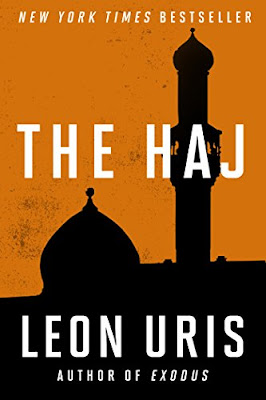
The Haj, by Leon Uris, had been sitting on my shelf begging to be read throughout spring and summer. For some reason, I always chose others, until The Haj was one of the few left that I hadn’t devoured. If I had known it would be that powerful, sad, uplifting and stirring, I would have read it sooner. The Haj takes us through the life of a Palestinian family and their Jewish friend, Gideon, over the course of several decades. It starts off in the early 1900s and carries us through WW2. 

Leon Uris is unapologetically pro-Israel; he freely admitted it during his lifetime. He is the same author who gave us Exodus, of which the Prime Minister of Israel at the time, David Ben-Gurion, said, "as a piece of propaganda, it’s the greatest thing ever written about Israel.” The Haj continues from an Israeli viewpoint and must therefore be understood in that context. Despite this caveat, I found the characters human, believable, and likeable on both sides. While the Haj is sometimes a brute, his youngest son is sensitive, caring and unlike his father. And even the Haj, the leader of his village, loves his Jewish neighbor in his own, strange way. While reserving judgment on Leon’s unabashedly one-sided account, I can wholeheartedly recommend The Haj as worthwhile and absorbing reading. 

Due to covid, my library canceled the coming overflow sale. I’m going to have to be content with borrowed books in the coming months, and pray for all our sakes that this covid nightmare ends before another year passes. Good luck and stay safe, everyone!

Kathleen Cook is a free-lance editor and the author of twenty books. A former copy writer/editor for Demand Studios, she also served as the Fictional Religion Editor for the ODP (Open Directory Project). She is currently the Arizona Authors Association newsletter editor. 

Tuesday, June 2, 2020

Book review by Mark D. Walker - House Made of Dawn

FIND THIS BOOK ON AMAZON HERE
I learned about the author of House Made of Dawn on an “American Masters” documentary, “Words from a Bear” that portrayed him as a voice of Native American Renaissance in art and literature, which led to a breakthrough of Native American literature into the mainstream. Like many Americans, my awareness of the Native American was raised by historian Dee Brown’s 1970 best-selling book, “Bury my Heart at Wounded Knee,” which told about the massacre of several hundred Lakota Indians (mostly women and children) by soldiers of the U.S. Army. Scott Momaday was brought up around places I’d lived and worked in Oklahoma, New Mexico and Arizona, and this book received a Pulitzer Prize for Literature.

The main character, Abel, has come home to New Mexico from war only to find himself caught between two worlds. The one world is modern and industrial, claiming his soul and leading him into a destructive, compulsive cycle of depravity and despair. The author expresses a wariness of the white man’s world and language:

On every side of him, there are words by the millions, an unending succession of pamphlets and papers, letters and books, bills and bulletins, commentaries and conversations. He has diluted and multiplied the Word, and words have begun to close in upon him. He is sated and insensitive; his regard for language—for the World itself—as an instrument of creation has diminished nearly to the point of no return. It may be that he will perish by the Word. 

In contrast, his grandfather would orient him to the rhythm of the seasons, the harsh beauty of the Southwest, and the ancient rites and traditions of his people. 

These things he told his grandsons carefully, slowly and at length, because they were old and true, and they could be lost forever as easily as one generation is lost to the next, as easily as on old man might lose his voice….And he knew they knew, (his grandsons) and he took them with him to the fields and they cut open the earth and touched the corn and ate sweet melons in the sun. 

Considered by some as the “dean” of Native American writers, Momaday was proficient in fiction, poetry, painting and printmaking. He used his familiarity with both Native American life and legend as well as the modern world, building a bridge between the two.

The New York Times Book Review found this book, “as subtly wrought as a piece of Navajo silverware.” And I’d agree with the critique of this book from The Paris Review, “both a masterpiece about the universal human condition and a masterpiece of Native American literature.” 


Walker was a Peace Corps Volunteer in Guatemala and spent over forty years helping disadvantaged people in the developing world. He came to Phoenix as a Senior Director for Food for the Hungry, worked with other groups like Make a Wish International and was the CEO of Hagar USA, a Christian-based organization that supports survivors of human trafficking. 

Several of his articles have been published in Ragazine and WorldView Magazines while another appeared in Crossing Class: The Invisible Wall, an anthology published by Wising Up Press. His reviews have been published by Revue Magazine as well as Peace Corps Worldwide, including one on Paul Theroux’s latest book, Figures in a Landscape. His honors include the "Service Above Self" award from Rotary International. His wife and three children were born in Guatemala. 

His book, Different Latitudes: My Life in the Peace Corps and Beyond, was recognized by the Arizona Authors Association for nonfiction and according to the Midwest Review, “. . . is more than just another travel memoir. It is an engaged and engaging story of one man’s physical and spiritual journey of self-discovery . . .”  You can learn more at www.MillionMileWalker.com